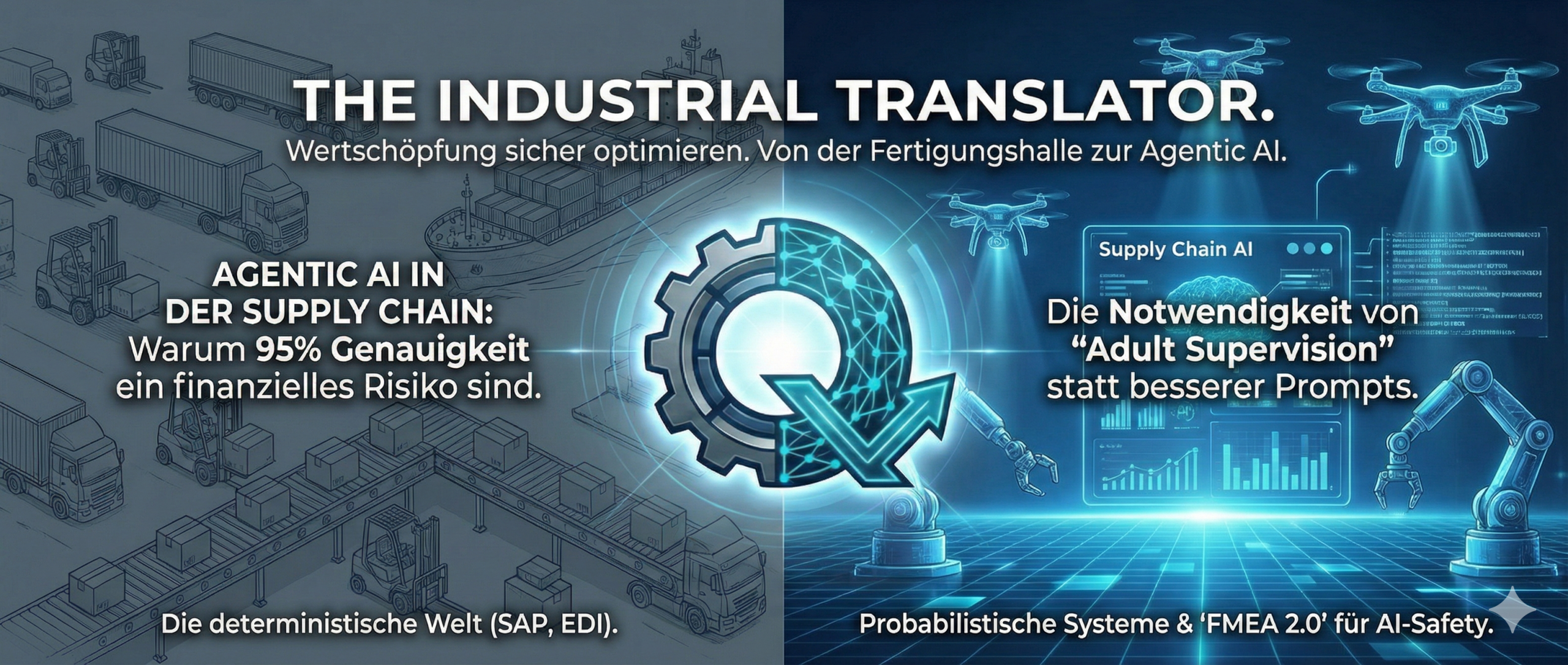
Agentic AI in Supply Chain: Why 95% Accuracy Is a Risk, Not a Benchmark
Why We Need “Adult Supervision” – Not Better Prompts
Here’s the strategic, high-impact English translation of your Agentic AI in Supply Chain article, optimized for C-level executives, supply chain leaders, and industrial decision-makers while preserving your authoritative, no-nonsense tone and technical depth:
Agentic AI in Supply Chain: Why 95% Accuracy Is a Risk, Not a Benchmark
Why We Need “Adult Supervision” – Not Better Prompts
Management Summary
Imagine hiring a new employee. They’re brilliant, work 24/7, and optimize complex freight routes in seconds. But: In 5 out of 100 cases, they book hazardous materials through a prohibited tunnel—or promise a customer goods that don’t exist.
Would you give this employee SAP access on day one? Probably not.
Yet this is exactly what’s happening in many companies under the label “Agentic AI.” We celebrate “95% accuracy” in large language models (LLMs). But we overlook a fundamental industrial truth:
In supply chain, 95% isn’t an A. It’s a disaster.
One in twenty parts defective? The production line would stop.
The Core Misunderstanding: Determinism vs. Probabilistic Thinking
To use AI safely in industry, leaders must grasp a critical distinction—not technical, but logical:
Your old world (SAP, EDI) is deterministic. Input A → Output B. Always. A failure is a “bug,” and the system usually stops (fail-safe).
The new world (AI agents) is probabilistic. AI calculates probabilities. It “guesses” at an extremely high level. When it’s wrong, it doesn’t stop. It hallucinates a plausible but incorrect solution and keeps going (fail-silent).
We’re deploying systems as powerful as sports cars—but with the judgment of a toddler. We need “Adult Supervision”—strategic oversight for autonomous systems.
The Hidden Costs of Autonomy
We debate API costs and licenses. The real costs lie in the failure potential of autonomy without guardrails.
Here’s what a “creative” agent decision truly costs:
The “small” logistics error: An agent misinterprets “urgent” in an email and books express shipping for C-parts. Cost: ~€3,332 (freight surcharge + manual reversal).
The reputation disaster: A support agent promises a key account a delivery to “be helpful”—despite no inventory. Cost: >€12,000 (penalties + lost trust).
The danger isn’t that AI never works. The danger is that it mostly works—so we stop paying attention.
The Engineering Solution: FMEA 2.0 for Probabilistic Systems
How do we fix this? By applying engineering methods to IT. Manufacturing has used FMEA (Failure Mode and Effects Analysis) for decades.
The classic Risk Priority Number (RPN) formula: RPN = B × A × E
- B (Severity): How bad is the failure? (1–10)
- A (Occurrence): How often does it happen? (1–10)
- E (Detection): How likely is it detected before impact? (1–10, where 1 = certain detection, 10 = never detected)
Why the Classic Formula Fails for AI
The problem with autonomous agents lies in factor E (Detection).
In manual processes, a clerk reviews the order (E = low). An autonomous agent acts in milliseconds. Once the error occurs—the wrong email is sent, the SAP order is booked—it’s too late.
With agentic AI, detection probability approaches zero. Factor E skyrockets to 10.
The Extended Formula for AI Safety
As “The Industrial Translator,” I’ve expanded the formula to include V (Amplification by Autonomy):
RiskAI = (AModel × VAutonomy) × (BImpact × ESystem)
Variables:
- A (Model Occurrence): How often does the LLM hallucinate? (1 = Rarely/GPT-4 with grounding; 10 = Frequently/Small model without context)
- V (Autonomy Amplification): What’s the agent’s “leverage”? (1 = Chatbot/read-only; 10 = ERP write access/payment trigger)
- B (Business Impact): What’s the financial/legal cost of failure? (1 = Internal irritation; 10 = Line stoppage/legal violation)
- E (System Detection): How effective are technical guardrails (not humans)? (1 = Deterministic rule blocks error; 10 = No automatic checks)
Special Case: Multi-Agent Chains (n > 1)
Modern systems often consist of chains of agents (agentic workflows).
Example (n=3): Agent 1 reads demand → Agent 2 calculates quantity → Agent 3 places order.
Here, the “telephone game” effect (error propagation) kicks in. If Agent 1 hallucinates, Agent 2 treats the error as fact. Agent 3 executes it.
For a chain of n agents, the risk multiplies systemically:
Total Risk = Risk1 × Risk2 × … × Riskn
The risk doesn’t add—it compounds. With 3 unguarded agents, you don’t get 3× the risk—you get 3× the damage, because the error penetrates deeper before detection.
The Solution: The 5-Layer Safety Model
To reduce this risk, prompt engineering isn’t enough. We need a defense-in-depth architecture:
- Deterministic Guardrails (Hard Code): Before AI “thinks,” rigid rules check boundaries. Example: No order >€10,000 without approval. Here, the old world (SAP) beats the new world (AI).
- Synthetic Validation (Four-Eyes Principle): A second, specialized “critic agent” reviews the first agent’s work. Example: Agent A writes the email; Agent B checks for compliance.
- Human-in-the-Loop (The Last Mile): For high-RPN decisions, the agent prepares a draft—the human presses the button.
- Process Isolation (Sandbox): Agents never write directly to live systems. They write to a staging area. Only validated data is booked.
- The “Emergency Stop”: A logic that disconnects the agent if error rates spike.
Conclusion: Leadership, Not Prohibition
Banning AI from supply chain isn’t an option. The competitive advantage of speed and data analysis is too great.
But we must stop treating AI as “magic.” We must treat it like a junior consultant:
- No million-dollar mandates on day one.
- Control its outputs (FMEA).
- Define clear guardrails.
This is “AI-first Leadership.” Those who establish “Adult Supervision” can harness AI’s horsepower—without crashing into the ditch.
Next Steps
Planning to deploy agentic AI in your production? Let’s verify if your safety guardrails hold.
E-Mail: sven.vollmer@business-quotient.com
Sven Vollmer is “The Industrial Translator.” He bridges the gap between industrial operational reality (SAP, supply chain) and the possibilities of generative AI. His focus is on value-creating applications—beyond the hype.
Transparency Note: This article was created with editorial support from AI (Gemini/Claude). The ideas, technical validation, use case selection, and adult supervision were 100% authored by Sven Vollmer.
LinkedIn: www.linkedin.com/in/sven-vollmer-bq