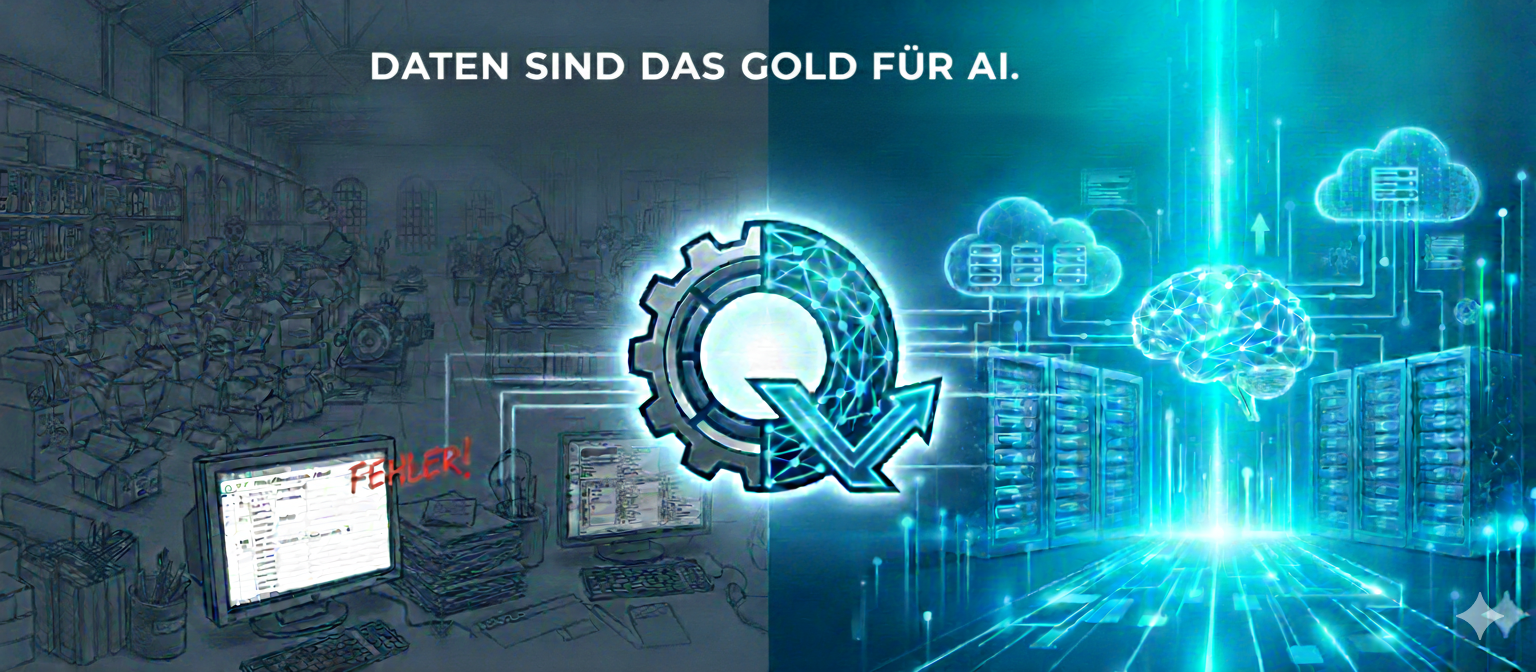
Why 86% of All AI Projects Fail on Data — Before They Even Start
The uncomfortable truth: Your AI problem isn’t a technology problem. It’s a master data problem.
The Number Nobody Wants to Hear
Gartner confirmed it in black and white in 2025: Only 14% of companies have data that’s ready for productive use of Generative AI.
Fourteen percent.
The flip side: 86% of companies currently investing in AI are building on a foundation that can’t hold. They’re buying the most powerful engine — and bolting it into a chassis without axles.
For me, this number isn’t a surprise. It’s the statistical confirmation of what I’ve witnessed across 30 years in industry — from SAP rollouts to digitalization programs to the current AI wave.
The algorithm is never the problem. The problem is upstream.
A Case from the Field: When Weights Are Missing
One specific example that stands for dozens of similar situations:
A major automotive supplier near Stuttgart. The company invested in a Transport Management System — technically sophisticated, cleanly designed, professionally executed. The goal: optimized route planning, reduced freight costs, better utilization.
Then came the reality check.
The system couldn’t calculate a single optimized route. Not because the algorithm was flawed. Not because the software had defects. But because the most fundamental master data was missing: weights and dimensions of the parts.
The information was either non-existent, obviously wrong, or buried in Excel spreadsheets that hadn’t been updated in years. No system in the world — whether classical optimization or cutting-edge AI — can work with data that doesn’t exist.
We had to completely redefine the project scope. What started as a software implementation became a master data cleansing project first. The timeline shifted by months. The budget was blown.
The Pattern: Three Levels of Data Failure
This case isn’t an outlier. Across three decades — from the furniture industry through SAP consulting to AI strategy — I’ve seen the same pattern in ever-new variations. Data failure manifests on three levels:
1. Missing Data
The information simply doesn’t exist in the system. Weights, dimensions, lead times, quality metrics — fields that were created in the ERP system but never populated. Everyone knows it. Nobody feels responsible.
2. Wrong Data
The information exists but is outdated or incorrect. A supplier changed their address, but the system still shows the old one. A material weight was estimated at initial creation and never validated. Prices from the last millennium sit next to current conditions.
3. Distributed Data
The information exists and is correct — but it’s in the wrong system. Or in a spreadsheet on a planner’s desktop. Or in an email from 2019. The truth is fragmented, and no algorithm in the world can assemble fragments it doesn’t know about.
Why AI Amplifies the Problem — Rather Than Solving It
Here lies the critical thinking error of many decision-makers: They believe AI is the solution to their data problem. “The AI will find the right patterns.” “Machine learning can learn from bad data.”
No. It can’t. Not in a way that could support operational decisions.
Traditional software fails visibly with bad data: A wrong address leads to a wrong delivery. It’s noticed. It gets corrected.
AI fails invisibly: A Large Language Model trained on or augmented with faulty master data produces results that sound plausible — but are wrong. It doesn’t just hallucinate when knowledge is missing. It also hallucinates when knowledge is wrong. And in an industrial context, a plausible-sounding but incorrect recommendation has the potential to cost millions.
The car analogy: Bad data in a traditional system is like a flat tire — you notice immediately and stop. Bad data in an AI system is like a creeping bearing failure — everything seems to run smoothly until the wheel comes off. At 180 km/h.
What the 14% Do Differently
What distinguishes the companies that are actually AI-ready according to Gartner? Three characteristics stand out:
Data Quality Is a C-Level Priority
In these companies, master data quality isn’t an IT topic managed in the back office. There are clear responsibilities, defined processes for data maintenance, and regular audits. The CFO or COO actively asks about the state of the data foundation — not only when a project fails.
Cleansing Before Innovation
These companies have the courage to prioritize “boring” projects. Master data migration, data governance, process harmonization — these aren’t lighthouse projects that impress at conferences. But they are the foundation everything else stands on.
Process Thinking Over Tool Thinking
The 14% don’t ask: “Which AI tool should we buy?” They ask: “Which process has the biggest lever — and what data do we need for AI to create value there?” The process determines the data requirement. The data requirement determines the cleansing project. And only then comes the technology.
The Industrial Translator Approach: Foundation First
This is exactly where I come in. Not as an AI evangelist promising the next revolution. But as someone who knows the gap — the gap between technological possibility and operational reality.
Across my career — from REFA engineer on the shop floor, through SAP consulting at Krone, Hella, and Bosch, to AI strategy at SupplyOn — I’ve learned one thing:
Every technology is only as good as the foundation it stands on.
Or put differently: You can build the most powerful engine in the world. If the chassis can’t carry it, nothing moves.
The 86% don’t fail because of AI. They fail because of what comes before AI. And precisely this groundwork — the translation between what technology needs and what the organization can deliver — is the core of my work as an Industrial Translator.
The Honest Question
Before you approve the next AI budget, ask yourself one question:
If an algorithm analyzed your master data today — what would it find?
Clean, current, complete datasets? Or a mosaic of gaps, legacy debt, and Excel workarounds?
The answer to this question determines whether your next AI project joins the 14% — or the 86%.
E-Mail: sven.vollmer@business-quotient.com
Sven Vollmer is “The Industrial Translator.” He bridges the gap between industrial operational reality (SAP, supply chain) and the possibilities of generative AI. His focus is on value-creating applications—beyond the hype.
Transparency Note: This article was created with editorial support from AI (Gemini/Claude). The ideas, technical validation, use case selection, and adult supervision were 100% authored by Sven Vollmer.
LinkedIn: www.linkedin.com/in/sven-vollmer-bq